

Food is supposed to support and nourish us. It is supposed to be nutritious and good for us. We eat food because we need fuel for our bodies, our minds. Food, they say, is medicine.
Is that true about our current food supply? That’s tough to say. Big Agriculture, the American Heart Association, and the idiots on Reddit think ‘We’ve come a long way, baby’, when it comes to what we have available to put in our mouths today.
Well, they’re right. We have come a long way. A hundred years ago, we ate what we killed. And whatever you could pull from your garden. We cooked with lard, butter, and beef tallow. Obesity, diabetes, and chronic disease were almost unheard of.
Fast forward to today, and things look a little different. Most Americans aren’t harvesting vegetables from their garden for dinner. They’re making it from something they bought from the grocery store. Sure, grocery stores have vegetables, but what are they putting on that healthy salad?
Why make bread from scratch when it’s right there on the shelf? For two dollars? Prepackaged, already made foods are just easier. Ninety percent of what’s available for purchase at your local grocery store is what Michael Pollan famously coined ‘food like substances’. They’re certainly cheaper and faster – so that’s what most people are eating. Cheaper, faster, and easier certainly sounds…better. But is it?
Americans are sicker and fatter now than ever. Obesity rates a hundred years ago were basically non-existant, now they’re at 42%. Incidence of chronic disease were unheard of, now 60% of americans have one. 40% have two or more. Anyone my age remember any kids in your grade school with diabetes? Hypertension? Obesity? Nothing unusual about that now.
So what happened? What is so dramatically different today to account for this? Believe it or not, we eat about the same total number of calories. Americans actually exercise more today than they used to. And yet we are the sickest, fattest country in the world. What’s different is our food. And our food is poisoning us.
‘Food like substances’ or ultra processed foods make up the majority of the standard American diet. This isn’t food. Sugar, fake sugar, fake ingredients are all bad. But today, I want to focus on the ingredient responsible for the overwhelming majority of calories in these foods. The single most processed food on the planet. The myth, the legend, the ever controversial topic: Seed Oils.
Let’s get into it.
“The further away from nature we get, the more we fuck it up.” –Me.
The Rise of Seed Oils
The story begins in the early 1900s with the industrial revolution. About the same time we stopped killing all the whales, factories were looking for alternatives to whale oil. Someone saw all the cottonseeds over there in the trash and had the brilliant idea to try to get oil out of those. Nice.
Cottonseed oil was used as an industrial lubricant for machinery. They also used it in soap, lamps, candles, and paint. It was way cheaper and definitely more environmentally friendly (well, to the whales, anyway) than traditional oil. Today it’s actually an environmental monocrop disaster funded by the government and Big Agriculture, but whatever – not relevant for this post.
An alternative fat was founded on a cotton farm more than 150 years ago, and that is how cottonseed oil was born.
Then, a little brother-in-laws company came along called Proctor and Gamble. Maybe you’ve heard of it. They caught wind of this cottonseed oil making situation and started mass production. But as electricity became more common, demand for candles was dwindling. That was no good. What to do with all this cottonseed oil? We can’t just throw it away. You know where this is going.
Proctor says to Gamble – ‘Hey, let’s market this extra cottonseed oil that we aren’t using in factory machinery, as….food!’
It was 1911. Enter, Crisco.
Crisco was the first time in history that an industrial seed oil was marketed as an actual food. An industrial oil to be consumed by humans. Crisco was hydrogenated cottonseed oil – that’s where take the oil, heat it to 500 degrees, add a metal catalyst, in a near vacuum and pump in some pressurized hydrogen, causing the carbon atoms in the oil to break and form other bonds with other carbons.
Crisco was marketed as a clean, pure, healthier, and 100% vegetarian alternative to lard.

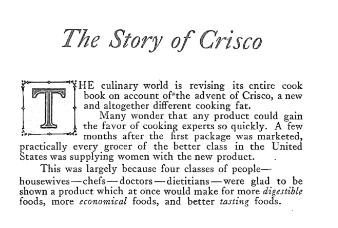
‘The Story of Crisco’ was published two years later, in 1913. Omg you totally need to read this book it is positively psychotic.
“Housewives, chefs, doctors, dieticians were glad to be shown a product which at once would make for more digestible foods…” Never mind the fact we had been digesting animal fats since the dawn of humanity. Whatever.
Cottonseed oil became a cheap alternative to traditional fats like butter and lard. Entire recipe books were rewritten – take out the butter and lard, use some Crisco instead. OK – so it’s cheaper than butter, it is in fact vegetarian, and reportedly ‘more digestible’. How does ‘healthier’ get added to the list? I thought you’d never ask.
At a little luncheon on April 14, 1948, Proctor and Gamble approached a group of doctors called the American Heart Association with a check for 1.7 million dollars. For ‘research’. 1.7 million dollars might not sound like a lot of money, but by today’s standards, that’s the equivalent of 22 million dollars in 2024. For research. On vegetable oil.
The American Heart Association went from being a relatively small, unknown association – because well, there just wasn’t any heart disease until, you know, people started eating Crisco instead of butter – to a much wealthier and influential one. Is it a bridge too far to think that by accepting that check, the American Heart Association would go on to endorse Crisco as a ‘heart healthy’ alternative to animal fats? Maybe it is.
Fast forward to the 1950s and President Eisenhower has a heart attack, Ancel Keys takes a check from industry to blame butter. Saturated fat and cholesterol were bad, sugar and seed oils were good, and the American public was fucked.
With the American Heart Association’s stamp of approval, we saw the rise of oils like ‘margarine’, soybean, canola, and corn oil. They were marketed as sexy, modern, healthy, and convenient.
Consuming seed oils does lower cholesterol, but if you follow me, you know that cholesterol doesn’t cause heart disease – inflammation and metabolic syndrome do. Which is why statins are stupid. I won’t rehash that argument here, but I’ll link it below. Lowering LDL cholesterol by consuming seed oils has never been shown by any study ever to decrease risk for cardiovascular disease – or any other disease for that matter.
https://lindgren.health/you-get-a-statin-you-get-a-statin-you-get-a-statin/
In 1965 there was a 3-year study on corn oil and heart disease. They fed 19 teaspoons of corn oil to subjects every day and compared them to a control group. The study had to be stopped early – at 2 years – because the people eating corn oil were dying at far higher rates than the controls. The researches concluded that “corn oil cannot be recommended as a treatment of ischaemic heart disease. It is most unlikely to be beneficial, and it is possibly harmful.”
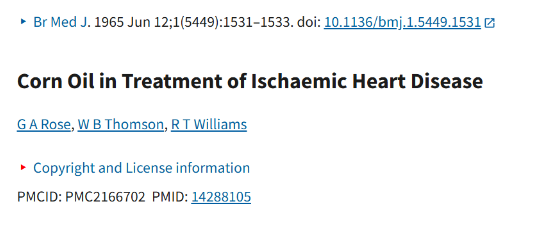
https://pmc.ncbi.nlm.nih.gov/articles/PMC2166702/
Study after study – minus the poorly conducted, flawed, or corrupted by industry studies – demonstrate a causal link between the consumption of highly processed polyunsaturated seed oils and chronic disease including heart disease and obesity.
Some experts argue that the rise in use of polyunsaturated seeds oils is responsible for 90% of the obesity and chronic disease seen in our country today.
These are oils derived from, well, seeds – and beans – soybeans to be precise.
Seed oils
- Soybean
- Corn
- Canola
- Cottonseed
- Rapeseed
- Grapeseed
- Sunflower
- Safflower
- Rice Bran
Before the 1900s, the American consumption of vegetable or seed oils (see how they did that? There’s actually no vegetables in vegetable oil – they’re just seeds from random plants), the American consumption of seed oils before the 1900s was ZERO. We didn’t have them. That consumption would rise exponentially over the 20th century to an average of 65 grams of seed oil per day. That’s 3-5 tablespoons of vegetable oil consumed per person, per day.
You don’t remember pouring a quarter of a cup of Wesson canola oil in your coffee this morning? That’s because you didn’t. Seed oils are just in everything. Literally. Bread, chips, crackers, coffee creamer, salad dressing, oat milk – they are in absolutely every processed food we buy.
In order to naturally consume 3-5 tablespoons of corn oil, you would need to eat about 70 ears of corn. 60 if they came from Sunny Hill. Consume 3-5 tablespoons of soybean oil? That would take somewhere in the arena of 2-3 pounds of soybeans. These are insane amounts of food that we would have never historically encountered.
And even if you won the corn eating competition at your local state fair, that naturally occurring corn oil isn’t what’s in that clear plastic bottle at the grocery store. Seed oil production requires an insanely toxic process capable only in a factory.
Want to lose your lunch, check out a YouTube video on how they make canola oil.

A massive increase in consumption of a novel food product, made in a factory, recommended as a health food by the American Heart Association – during the same period of time we see an explosion in rates of obesity and chronic disease. This is the single biggest change in diet that we’ve seen in all of human history.
Seed oils contain almost exclusively something called linoleic acid or omega-6 fatty acid. This is an extremely inflammatory fatty acid that accumulates in our brains and the membranes of our cells. They literally cross the blood brain barrier. It sets up an environment in our bodies that is pro-oxidative, pro-inflammatory, and straight up toxic.
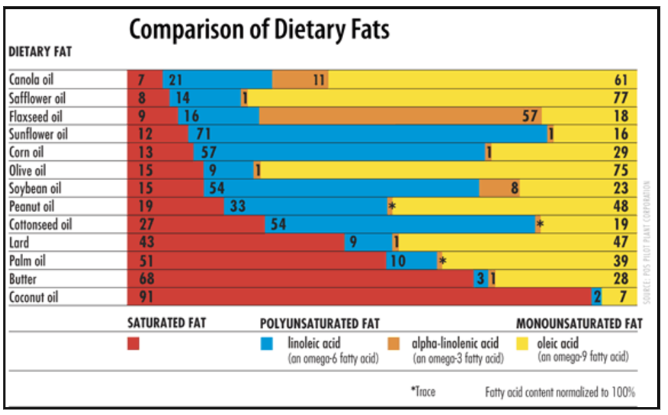
You’ll hear Redditors argue that omega-6 isn’t inflammatory, that it’s a naturally occurring fatty acid found in all dietary fats. OK, sure. If omega-6 is appropriately balanced with anti-inflammatory omega-3 then right, not a problem. But check this out. The omega-6 content of these oils is the blue. You see the size of the ‘blue line’ in sunflower and canola oil compared to the ‘blue line’ in butter and coconut oil.
You tell me which ones are sus.
https://en.wikipedia.org/wiki/File:Comparison_of_dietary_fat_composition.png
My favorite are the doctors, the cardiologists, on TikTok regurgitating this rhetoric. ‘Seed oils are heart healthy.’ ‘The omega-6 linoleic acid online discourse is simply fear mongering.’ Well doctor so and so – you go right ahead and eat as much of them as you’d like. I’ll pass.
But the toxicity of seed oils isn’t just about omega-6 content. These oils are straight up fake, made in a lab, Frankenfoods.
Just like there are absolutely no vegetables in vegetable oil, there is absolutely nothing natural about how seed oils are created. Let’s just take a look at what’s involved here.
First, the seeds need to be heated up to 500 degrees Fahrenheit.
Well, let’s back up – and just go over the processing and production of the granddaddy of these beauties: Canola oil.
Canola oil isn’t made from corn or the mythical ‘Canolo’ plant. It is made from a specific variety of Rapeseed – I know – unfortunate name, which is a relative of the mustard plant. Before the 1970s, Rapeseed oil was not considered safe for human consumption because it contained high levels of erucic acid, which kills your heart.
But with a little genetic engineering, researchers at the University of Manitoba were able to breed that inconvenient trait out. Then scientists at Calgene (now Monsanto) genetically modified Rapeseed to make it tolerant to Glyphosate and we were ready to rock.
The name “Canola” is a trademarked hybrid of the words “Canada” and “oil”. It was created by a Canadian manufacturer to distinguish their low-acid Rapeseed oil from natural Rapeseed oil. Which is convenient – because the regular acid Rapeseed oil will kill you much faster than the low-acid variety.
Genetically modified sprayed with Round Up “Canola oil” is then made by crushing the seeds of the Rapeseed plant in a giant metal press to release the oil. Which comes out looking like a cross between vomit and baby poop. This “conditioning” stage requires the addition of about 500 degrees of steam to increase oil yield and facilitate extraction. It also causes the seeds to oxidize – or become rancid, in more general terms.

You know what rancid smells like? Yeah – no bueno. No one’s going to eat that. You would actually run screaming away from that. No worries – we’ll fix it in a sec.
The oil is then ‘cleaned’ with a chemical solvent called hexane – a process that infuses poison into the sludge, sucks out any beneficial vitamin E, and increases omega-6 content. The rancid, hexane oil is then “deodorized”, so it doesn’t smell like ass, and cooled. It’s then packaged in clear plastic bottles which further oxidize on the shelf at your local grocery store.
These oils are highly unstable. When heated, they produce numerous toxic byproducts which contribute to chronic diseases like cancer, diabetes, obesity and heart disease. Studies have shown that high consumption of omega-6 fatty acids—found in seed oils—create an imbalance with omega-3s which leads to chronic inflammation.
Seed oils are everywhere—from your salad dressing to your granola bars. The high consumption of foods rich in rancid factory produced omega-6 fatty acids contribute to every metabolic, inflammatory, and neurodegenerative disease we have. And with chronic diseases like obesity, diabetes, and autoimmune disorders on the rise we need to ask ourselves – Is there really a question regarding their connection?
What Can You Do?
Read Labels
So, what can you do to protect yourself? Start by reading labels. Actually, start by staying outside of the inside of the grocery store. If you have to read a label, you’re likely holding one of Michael Pollan’s ‘food like substances’. Frankenfoods. Ultra processed foods make up close to 75% of the food supply in the United States and the vast majority of those contain seed oils.
Shop the perimeter of the grocery store and fill your cart with as much of those things as possible. If you have to dive into the center aisle lion’s den, avoid anything with the “Hateful Eight”, as Dr. Cate Shanahan likes to call them: canola, corn, cottonseed, soy, sunflower, safflower, grapeseed, and rice bran oils. Switch to natural fats like olive oil, avocado oil, coconut oil, beef tallow, ghee, or butter.
Get That Sh*t Out of Your Pantry
Take a gander around your home. Get rid of the Wesson canola oil, the fake butter in the fridge, the “Pam” cooking spray. Use real stuff instead. This crap about ‘saturated fat’ being bad for you is so yesterday’s news. Hey social media,1985 called and wants their shit talk about coconut oil back.
Saturated oil causes heart disease is officially debunked. Moving on.
Quick caveat: According to not so recent investigative reports on 60 Minutes and in the New Yorker magazine, we should be careful with olive oil: “70% of extra virgin olive oil is probably a fraud.” So much of it is contaminated with other oils or is just a seed oil fraudulently labeled as olive oil. Look for organic, single source, cold pressed, unrefined oil in an opaque glass container. That’s the cats ass.
It’s best not to heat these oils. If you’re going to cook with oil, it should be an animal oil like butter, ghee, or beef tallow. Seed oils and smoke points is a whole other issue. You want fries? Fry them in beef tallow. You’re welcome.
Stop Eating Fried Food
The vast majority of foods fried in restaurants in the US are fried in soybean oil. You can’t get around this. I’m a firm believer in poison has a dose. Most people aren’t going out to eat because they think they’re doing something healthy. They do it for a treat. If you love a good deep fried cheese curd from Renard’s – I’ve heard they’re good, but wouldn’t know first hand – ok I might – then treat yourself. But don’t treat yourself every day. I know you’re good, but let’s be honest. You’re not that good.
Conclusion
Eating clean or even just cleaner can seem like a daunting task. I get it. Take it one change at a time. It’s not a sprint. Making sustainable life changes is a marathon. I encourage you to look at it through the lens of evolution. Not how we may or may not have evolved from monkeys to humans (or humans being genetically engineered by aliens – whatever), but simply by what practices have kept humans alive on this plan for thousands of years.
Frankenfoods like seed oils were ‘invented’. Quite literally invented yesterday. We don’t have long term data on the safety of fake, ultra processed foods on our health and longevity, but we do have short term ones. And those aren’t good. Make choices about food as if you were a cave person. Cave people didn’t have coffee creamer. Unless you’re creaming your coffee with actual cream, I just wouldn’t. Black coffee is so good. Learn to like it.
Be skeptical of industry and special interest. Just because a product says “heart-healthy” doesn’t mean it’s good for you. Just because a company that makes a new kind of infection prevention injection says their product is “safe and effective”, doesn’t mean it protects against illness and transmission. I’m looking at you Tony, Joe, Bill, and Rochelle.
The truth is, the science is far from settled – quite frankly science these days is mostly a class 5 disaster zone. I just made that up. I don’t think that’s actually a thing. The added influence of money in nutrition science means we have to stay extra vigilant. Seed oils may not seem evil at first glance, but sometimes the most dangerous threats are the ones hiding in plain sight. Afterall, they were admittedly made in a lab somewhere. Applying that standard to anything you put in your body is a pretty darn good place to start in my opinion.