

Introduction: The Emerging Concern of Post-Vaccination Syndrome (PVS)
Anyone else notice that everyone around you is sick? What’s wrong with everyone? Worst cold ever in your whole life—for the second time this season? Weird freaking rash no one’s ever seen before. Gut is trashed. Brain doesn’t work. Can’t sleep. Joints hurt. Autoimmune what? Pancreatitis? Is that a thing? Oh, and now you have cancer too? And so does your neighbor. And her neighbor. Well, that’s just perfect.
And then there are these terrifying graphs all over X. Cancer and overall death rates are at an all-time high. At the same time? Insurance companies are not having a good fiscal year. Or the past five years. Are all these things connected, or is Mercury just perpetually in retrograde this year?

Last week, I reviewed the post-vaccination syndrome (PVS) data from the Yale LISTEN study. I ripped out at least half of what I had originally written, which may have inadvertently included information on the full extent of those findings as well as what we can do from a positive standpoint moving forward. Whether you’ve had one shot, seven shots, this shot, or other shots, we know that there is the potential for immune system dysregulation. Plus, we live in a world full of other things that tax our immune systems—crap in our water, crap in our food, crap in the air. All of these things are a real drain on our body’s ability to do its most important jobs: prevent serious infections, autoimmune disease, and protect us against cancer.
This week, I’d like to take another swing at this—dedicate time to “OK, so we’re here now. What might we expect to see from a health standpoint, and what can we do about it?” If learning about what immune system dysfunction might mean for you or your loved ones and what can be done about it sounds interesting to you, then grab your headphones, and let’s go.
The Immune System: Friend or Frenemy?
So, we all have an immune system. Your immune system is supposed to be your friend. Killing viruses and bacteria. Taking down cancer cells, wiping out parasites and other bad guys. But like all friends, your immune system can get caught up with the wrong crowd. Have you seen Mean Girls? Or read anything on that whole Blake Lively/Justin Buldoni situation? Omg. Don’t come at me.
The post-vaccination syndrome outlined in the Yale LISTEN study last month shed light on a potential new problem some people are experiencing after the jab, but the immune system failure they outlined isn’t a new one. Autoimmune disease, cancer, chronic infections, and latent infection reactivation all demonstrate the same pattern of immune system problems.
Immune System 101
So, being a member of an immune system is not unlike being a player on your local football team. There are offensive players, defensive guys, coaches, cheerleaders, and commentators—seriously, everyone’s included. And if you’re from Green Bay, WI, like me, you know football is a big deal here, so let’s break this down in terms that make sense to any die-hard Packers fan.
- CD4 Cells = The Coaches & Quarterbacks – They call the plays, tell the offense where to go, and make sure the defense knows the enemy’s next move. Without them, the team is lost.
- CD8 Cells = The Defensive Line – These guys tackle invaders head-on. They are the enforcers, stopping infections (or opposing players) before they make it to the end zone.
- B Cells = The Wide Receivers – They catch the antigen (ball), memorize the play (infection history), and generate antibodies (touchdowns) to ensure the immune system remembers what worked before.
- Macrophages = The Offensive Line – They clear out dead cells and debris so the team can keep playing without tripping over last week’s wreckage.
- Cytokines = The Commentators – They announce what’s happening on the field, sending messages between players to make sure everyone is on the same page. But if there’s too much noise (inflammation), the messages get jumbled.
But what happens when your quarterbacks (CD4 cells) are missing, your defense (CD8s) is exhausted, and your coaches can’t call effective plays? Well, that’s what we’re seeing in post-vaccination syndrome (PVS) and other chronic immune dysfunctions
Expanded Immune Dysfunction Comparison Chart

Key Immune System Changes Observed in PVS
1. Low CD4 Counts and Immune Suppression
Picture your CD4 cells like the team’s coaching staff—calling the plays, reading the opposing team, and making sure everyone is where they need to be. But what happens if your coaches are benched? Suddenly, the defense is confused, the offense is scrambling, and nobody knows what the next play should be. That’s exactly what happens when CD4 counts drop too low. Without enough of these immune system quarterbacks, your body can’t coordinate a proper response to infections, tumors, or other threats.
What that means for you:
- You’re more prone to infections—bacteria, viruses, even fungal infections that your immune system used to handle with ease.
- Your body doesn’t mount a strong response to new threats, so you take longer to recover when you get sick.
- Cancer risk increases because CD4 cells also help in spotting and destroying rogue cells before they turn into something worse.
2. Elevated CD8 Counts and T Cell Exhaustion
So now you’re down a coach, but let’s say your defensive line (CD8 cells) decides to go full beast mode to compensate. Initially, this sounds great—more defense! More sacks! But here’s the catch: they start getting exhausted. If they’re constantly battling infection, inflammation, or rogue cells without proper coordination from CD4s, they eventually stop working properly. Instead of taking out the bad guys efficiently, they get sloppy—causing inflammation, mistargeting healthy cells, or just burning out completely.
What that means for you:
- Persistent low-grade inflammation—your body is stuck in a fight, even when it doesn’t need to be.
- Inability to clear infections—your immune system is overworked but ineffective, so things like chronic Lyme, EBV, or other viral infections stick around.
- Autoimmunity risk goes up—because exhausted CD8 cells can start attacking your own tissues instead of just pathogens.
3. Elevated TNF-Alpha and Chronic Inflammation
If CD4s are the coaches and CD8s are the defense, TNF-alpha is like the overly enthusiastic sports commentator who never stops yelling. A little bit of TNF-alpha is great—it helps rally the immune system, promote healing, and drive out infections. But too much? It’s like a stadium announcer who just won’t shut up, keeping everyone in a constant state of stress and overreaction.
When TNF-alpha is stuck on full blast, your immune system never gets to rest, repair, or reset. Instead, it’s always in fight mode, leading to tissue damage, neurological inflammation, and higher disease risk.
What that means for you:
- Chronic tissue damage—inflammation isn’t just uncomfortable; over time, it physically breaks down tissues and organs.
- Higher autoimmune disease risk—your body starts seeing your own tissues as a problem and begins attacking them.
- Neurological symptoms—TNF-alpha is linked to brain fog, sleep issues, and neuroinflammation (think long COVID, post-vaccine neurological issues, or even neurodegenerative diseases like Alzheimer’s).
How Chronic Infections Keep Coming Back Like a Bad Ex
You know that one ex who just won’t go away? Maybe they’re blocked on everything, but somehow, someway, they manage to pop back up when you least expect it? That’s basically what happens with chronic and reactivating infections—they lie low for a while, waiting for the perfect moment to make their unwelcome return. And in people dealing with post-vaccination syndrome, immune exhaustion, or long-term stress, it’s like rolling out the red carpet for these infections to come back in full force.
The usual suspects? Tick-borne infections (Lyme, Bartonella, Babesia), reactivating viruses (EBV, CMV, HHV-6), and let’s not forget COVID/persistent spike protein-related dysfunction.
At first, they might just be a minor annoyance—fatigue here, some swollen lymph nodes there. But then the symptoms drag on for months or years, cycling through periods of improvement and relapse. Joint pain, brain fog, crushing fatigue, unexplainable autoimmune symptoms, weird rashes, random fevers… sound familiar?
How to Tell If a Chronic Infection is Reactivating
If you’re feeling like your body is in a constant state of battle, but no one can quite tell you why, here’s what might be happening under the surface:
- Crushing fatigue that doesn’t improve with rest (like, “fell asleep in my car in the driveway” kind of tired)
- Brain fog so thick you forget why you walked into a room
- Lingering sore throat, swollen lymph nodes, and flu-like symptoms that come and go
- Unpredictable joint pain that makes you question if you secretly have arthritis at 35
- Autoimmune disease flares (RA, lupus, MS suddenly getting worse with no explanation)
- Long COVID-type symptoms—post-exertional crashes, POTS, unrefreshing sleep, and random inflammation
Sound familiar? That’s because these infections aren’t gone—they’re just hiding out, waiting for an opportunity to come roaring back.
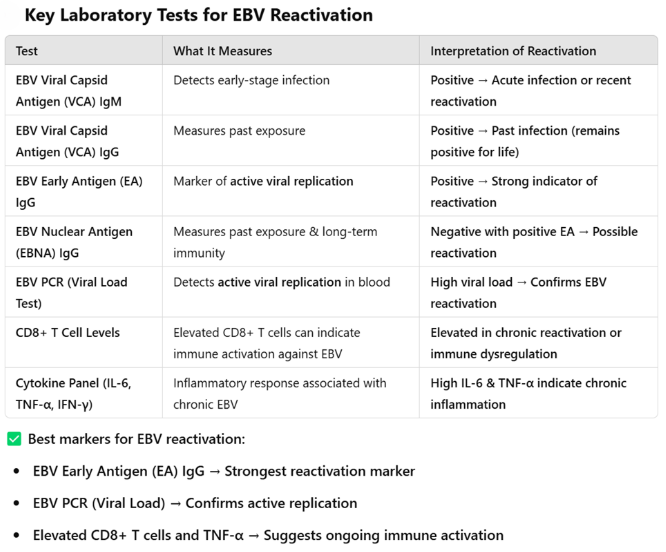
The Lab Work That Actually Tells You What’s Going On
If you suspect an infection is playing puppet master with your health, here are the tests that can help confirm what’s going on:
- EBV Early Antigen (EA) IgG – Tells us if EBV has reactivated (if it’s positive, it’s time to take action).
- EBV PCR (Viral Load) – Confirms if there is actual, active EBV replication happening right now.
- CD8+ T Cell Levels – Elevated CD8 means your immune system is in battle mode against viral invaders.
- Cytokine Panel (IL-6, TNF-α, IFN-γ) – Chronic infections trigger inflammation, and these markers show us just how bad it is.
- Tick-Borne Panels (IgM/IgG for Lyme, Bartonella, Babesia) – Because Lyme disease never really gets a permanent eviction notice, and its co-infections often go undiagnosed.
- COVID Persistence Testing (Spike Protein Antibody Panels, T Cell Markers) – Some people are still dealing with persistent spike protein issues affecting immune regulation.


How to Take the Pressure Off the Immune System and Finally Get Ahead
So, what do you do when your immune system is stuck in a loop, constantly battling infections it just can’t clear? You take the pressure off, support it with the right tools, and help it finally break the cycle.
Therapeutic Options That Work
- Supportive Oligonucleotide Therapy (SOT) – This is a game-changer for chronic infections like Lyme, EBV, CMV, and others. SOT disrupts viral replication and bacterial survival, helping the immune system clear the infection without the constant overactivation and inflammation.
- High-Dose Vitamin C – Not just for colds. IV Vitamin C acts as a pro-oxidant at high doses, directly damaging infected cells while also boosting immune function and reducing inflammation.
- Thymosin Alpha-1 (TA1) – If your immune system were a boxer, TA1 is the coach whispering in its ear between rounds. It helps CD4 and CD8 cells function properly, improves antiviral defense, and helps regulate the immune system to prevent autoimmunity.
https://www.wjgnet.com/2220-3249/full/v9/i5/67.htm
https://www.bmj.com/content/388/bmj-2024-082583
https://www.nature.com/articles/s41598-018-30956-y
- Low Dose Naltrexone (LDN) – LDN modulates immune function and reduces inflammation, particularly in autoimmune conditions and chronic infections.
- Curcumin & Anti-Inflammatory Support – Because chronic infections drive inflammation, and inflammation feeds the infection cycle. Curcumin, resveratrol, and omega-3s help keep things in check.
- Mistletoe Therapy – Used primarily in cancer, mistletoe also stimulates immune activity and enhances the body’s ability to fight chronic infections.
https://pmc.ncbi.nlm.nih.gov/articles/PMC7340679/
https://www.liebertpub.com/doi/10.1089/jicm.2023.29117.abstracts
- Detox Pathway Support – If the liver, lymphatic system, and gut aren’t clearing out toxins from chronic infections, they’re just getting recycled back into the bloodstream. Binders, infrared sauna, lymphatic movement, and gut support can help reduce the toxic burden.
Why These Strategies Work
Instead of just suppressing symptoms (hello, endless rounds of antibiotics and antivirals that don’t seem to work), these strategies address the root causes of immune dysfunction:
- They lower the infectious burden so the immune system isn’t constantly in overdrive.
- They modulate inflammation so your body stops attacking itself in the process.
- They rebuild immune function so it can actually handle threats appropriately moving forward.
If you’re dealing with chronic infections that just won’t go away, these are the tools that can help turn the tide in your favor.
Final Thoughts
We are seeing a pattern—immune dysregulation leading to persistent infections, autoimmune disease, and increased cancer risk. But here’s the good news: we’re not powerless. The ability to test, understand, and intervene is here.
Whether through targeted lab work, immune-modulating therapies (SOT, LDN, thymic peptides, mistletoe), anti-inflammatory support, detoxification, or optimizing mitochondrial function, we can help the immune system regain its balance and resilience.
This isn’t about waiting for things to get worse—it’s about taking proactive steps now. If this is resonating with you, stick around because this conversation is just getting started. Stay tuned for more deep dives into functional medicine solutions, and in the meantime—protect your immune system like it’s your best friend. Because it is.