

“Russia’s Anti-Aging Discovery—Buried by Bureaucracy or Hidden by Design?”
Cold War secrets, hidden Russian research, and tiny peptides that might rewrite the rules of aging.
No, you haven’t stumbled onto a lost Tom Clancy novel —I’m Dr. Kristen Lindgren and this is Episode 4 of The Peptide Files.
Today, we’re diving deep into the covert world of something called peptide bioregulators—compounds discovered in secret Soviet labs and buried beneath bureaucracy for decades.
What were the Russians hiding? What did they discover? Tiny, potent, and barely known outside Russia, these peptides promise profound impacts on aging, immunity, and organ regeneration.
So why haven’t you heard of them? And why are these potent anti-aging peptides still so hard to access today? Buckle up folks, because this file just got declassified.
The Birth of Bioregulators
It’s the height of the Cold War. Soviet Union, circa 1970-something. Drab concrete buildings, secretive underground laboratories, and scientists scurrying around under constant surveillance. The Kremlin isn’t just interested in missiles and moonshots; they’re obsessed with biological supremacy—specifically, how to keep soldiers sharp, cosmonauts healthy, and maybe even unlock the secret to eternal youth.
Enter Dr. Vladimir Khavinson, a brilliant but shadowy military physician. Tasked by Soviet authorities with solving the inconvenient problem of accelerated aging and tissue damage from intense radiation exposure (you know, typical Cold War stuff).
I don’t know why but every time I read about this guy I envision Dr. Evil. Anyway, Khavinson and his team began to study sharks with laser beams on their foreheads – wait no – they discovered the microscopic world of peptides—tiny fragments of proteins.
But these aren’t your run-of-the-mill peptides. No no. These are peptide bioregulators—ultra-short chains of amino acids, just two to four units long, so simple yet insanely powerful. Imagine them as molecular whispers that can command aging cells to behave young again, essentially hitting the cellular rewind button.
And here’s where things get wild: initial Soviet experiments start yielding jaw-dropping results. Animals given these tiny peptides aren’t just healthier—they live longer. I mean significantly longer. We’re talking lifespan increases of 30% or more. Human trials quickly follow, and suddenly aging eyes sharpen, immune systems reboot, and memory improves to levels thought impossible.
The Soviet brass is both intrigued and terrified. Could it really be this easy? Could tiny peptides crack the aging code? Of course, instead of sharing their revolutionary findings, they do what any good Cold War regime does—they lock the research in a bureaucratic vault labeled “shhht”.
Or just “top secret”.
And so, these remarkable bioregulators, capable of extraordinary cellular rejuvenation, sit hidden behind the Iron Curtain, quietly transforming the health of the Soviet forces and elite while the rest of the world remains in blissful ignorance.
Curious yet? You should be. Because when it comes to scientific secrets, nothing stays buried forever.
Let’s get into it.
Why Don’t You Know About These?
So, here’s the million-dollar question—or perhaps, more accurately, the multi-billion-dollar question: if these peptide bioregulators are such miraculous game-changers, why haven’t you heard about them until now?
Well, the answer might be no more exciting than exactly what you would expect it would be. First off, let’s talk patents—or rather, the complete absence of them. These tiny peptides can’t be patented easily. They’re naturally occurring molecules; simple, powerful, and unfortunately for Big Pharma, virtually impossible to monopolize. And we all know what that means—no patents means no profit. No profit means there’s nothing to see here.
Then there’s the FDA, America’s favorite gatekeeper of medical information – and it’s supporting cast of strategically placed misinformation, disinformation, and everyone’s favorite – “malinformation”. Strangely quiet about peptide bioregulators, the FDA seems to view these miraculous molecules with aloof disinterest or warning suspicion. Don’t go looking at those things. Why? Could it be that affordable anti-aging solutions might disrupt billion-dollar industries built on treating chronic illnesses rather than curing them? I say this every time – there is no money in wellness people. Big medicine is big business.
Let’s shine a spotlight on something called ‘Epitalon’, the poster child of peptide bioregulators. Studies show that Epitalon can literally lengthen telomeres—the protective caps on the end of your DNA. Longer telomeres mean younger cells, longer lives, and fewer signs of aging. Real-world results? Improved sleep, balanced hormones, boosted immune responses—the kind of benefits pharmaceutical giants could charge fortunes for. If only for a patent, of course.
But these peptides aren’t widely available at your local pharmacy or health food store. Instead, they’ve sparked an underground movement of biohackers, longevity enthusiasts, and renegade scientists quietly sourcing and using these compounds. Anecdotal tales abound—individuals discreetly reversing biological aging, improving eyesight, regenerating their immune systems, all while mainstream medicine stays strangely silent.
Inside the Science
Now, let’s take a look behind the scientific curtain. How exactly do these tiny peptides achieve such extraordinary results?
Here’s the secret: peptide bioregulators act like biological command codes, switching genes on and off at the DNA level. Think of your DNA as software that’s gotten glitchy with age. The peptides function like a reboot, restoring genetic expression to its optimal youthful state. Simple, elegant, and absolutely mind-blowing.
Unlike traditional signaling peptides—which bind to receptors on the outside of a cell membrane and initiate a cascade of intracellular events—peptide bioregulators take a much more direct route. These ultra-short peptides can actually enter the cell and pass into the nucleus itself. Once inside, they interact directly with DNA and histone proteins, subtly influencing something called epigenetic expression. If genetics are your hardware, epigenetics are the software. In simple terms: they help determine which genes get expressed and which stay silent, nudging cells back toward a healthier, more youthful operating system. It’s not just signaling from the outside—it’s reprogramming from within.
Let’s break it down even further. Imagine the control panel of your cells becoming cluttered with age-related switches flipped the wrong way. Peptide bioregulators enter this cellular control room, flipping these genetic switches back into their youthful positions. In essence, they communicate directly with your DNA, delivering messages like, “Hey, remember when you were young and vibrant? Let’s do that again.”
Curious about specific players? Here’s the quick-hit list of superstar peptide bioregulators:
- Endoluten – targets the pineal gland; boosts sleep quality, hormone balance, and cellular longevity.
- Vladonix – revitalizes your thymus gland, dramatically improving immune system resilience.
- Cortexin – sharpens brain function, memory, and cognitive performance.
- Ventfort – rejuvenates vascular health, enhancing blood flow and organ vitality.
There are somewhere between 21 and 26 different organ-specific bioregulators in all, depending on who’s splitting them up and how. Just to keep things confusing, there are injectable bioregulators, natural bioregulators and synthetic bioregulators. In the spirit of keeping things fun, they also all have different names – and some have the same name with different spellings. Did I mention they’re in Russian? You love this right? I tried to find a comprehensive chart online but they all suck. So I made one. Here you go. I’ll include it in the blog post on our website.
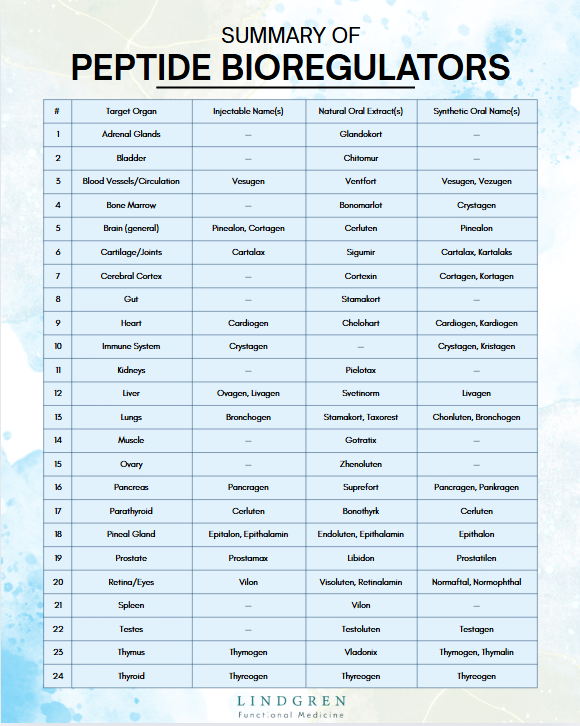
Much of Khavinson’s original work was done using the injectable formulations, but then he shifted over to the oral ones – now everyone pretty much uses those. They’re easier to take, easier to source although still tricky, and have the same efficacy. In recent years, we’ve had a company repackage the original formulation oral bioregulators into boxes written in English. So instead of expecting my staff to know what ‘Vladonix’ is, the box says ‘Thymic Bioregulator’ right on the front. Quite honestly, the Russian was more fun. I might just go back to the original packaging.
Understanding Peptide Bioregulator Dosing
OK – let’s talk briefly about something almost nobody explains well—how to actually dose these things if you’re serious about results. Generally speaking, bioregulators are cycled and stacked. Meaning, study participants didn’t take them every day for the remainder of their live,s and they rarely took just one. Khavinson would basically have everyone take the big three – Pineal, Thymic, and Circulatory as a base and add on two more, depending on which organ system he was targeting. So, like FIVE, different bioregulators at a time. Here we go:
Example Cycle 1:
- 2 capsules daily for 30 days.
- Rinse and repeat 1-2x a year.
Example Cycle 2:
- 2 capsules daily (either split AM/PM or taken together) for 90 days straight.
- Then, take a break for 30-60 days before cycling again.
Example Cycle 3:
- First month: 2 caps daily x 30 days.
- Second month: 2 caps daily x 10 days, break x 20 days.
- Third month: 2 caps daily again x 10 days, break x 20 days.
- Forth month: 2 caps daily again x 10 days, break x 20 days.
- Then repeat the 10 day cycles 3-4 times a year thereafter.
If you’re taking three to five bioregulators at a time, that’s a lot of pills, but…you want to live to be 120 or what?
Remember, bioregulators aren’t “medications” forcing a synthetic action. They are subtle, natural epigenetic nudges. Going longer and slightly higher in dose tends to amplify results safely. There’s really only one known downside to aggressive dosing. Cost. A 10-day course of a bioregulator can set you back…one million dollars.
It’s my last Dr. Evil bit, I swear. Bioregulators aren’t cheap, but you’re only taking them for 60 days out of the year – unless we’re going after a big problem. Sixty total days out of the year doesn’t bankrupt anyone.
The bigger issue is getting your hands on them. Until recently, you just couldn’t. The first bioregulators I ordered took months to deliver. I can only speak for our specific supply chain, but we always have these on the shelf. Amen.
Clinical Insights
The studies on these things are wild. Over the course of several decades, Khavinson studied his bioregulators on children, the elderly, wounded military personnel, physicians, elites – and I can’t find any negative studies. Kids needed less asthma medication – or none at all. Vision, damaged in combat, completely reversed. Cancers regressed. Dementia disappeared. Pain and mobility improved. Damaged organs healed. People were less sick, they slept better, had more energy. But most remarkable of all, they lived longer.
I think we can all agree that we have two ages. The one determined by your date of birth, and the one determined by the miles on your engine. Got me? One way to measure ‘mileage’ on a human is by measuring something called telomere length. Telomeres are like little protective end caps on your DNA. You know what an ‘aglet’ on a shoelace is? That hard plasticky thing on the end? That’s a telomere. Every time your cells divide, the telomeres on the ends of the DNA get shorter and shorter. Once they get too short, the cell dies. Just like when the aglets on your shoelaces go to hell. Forget lacing up your shoes with no aglets. It’s time for new ones.
Khavinson followed all sorts of outcome data, but he kept a particularly close eye on telomere length. As people age, telomeres just naturally get shorter. It’s one of the leading theories about what causes aging. Using foundational peptide bioregulators like pineal, thymus, circulatory, and brain 60 days a year, year over year, an interesting pattern emerged. As study participants got older in age, they lost miles on their cars. Their telomere lengths got consistently longer – not shorter. Just staying the same length would have been miraculous, but they didn’t – Khavinson’s bioregulator users were not only healthier and happier, they appeared to age in reverse.
Well that’s interesting, now isn’t it?
Can Peptides Rewrite the Rules of Aging? I Think We’re Onto Something
Aren’t peptides fun? I hope you all are enjoying this series as much as I am. I could run through peptides all day. Clearly, I talk too much. Remember, bioregulators are a special breed of peptides. Smaller, craftier. They’re not medications or hormones. 99% of the time, they’re taken by mouth, not an injection. They have no toxicity data (that I can find anyway) but a whole lot of long-term data to explain why you probably don’t know much about them and might have a hard time finding them.
Remember – we have them. In stock. In English.
If these peptides deliver even half of their published benefits, we’re looking at a real medical breakthrough – one capable of quite literally, rewriting the rules of aging. “Aging” might not be what you think…😊