


I’ve written fairly extensively about methylene blue in the past. I’ve been using it in my functional medicine practice for years. I used it in conventional medicine for decades, and it’s been in use as a therapeutic in general for more than a hundred years. Methylene blue is not new. It’s old. We’ve been using methylene blue in medicine for YEARS. I realize your average Redditor is somewhere between bot and idiot, so I don’t usually let completely inflammatory and ignorant comments get to me but mmmmmm. We’re entering the arena of ‘you’re not a horse, you’re not a cow, seriously y’all stop it’ with the hate posts on methylene blue. And so – I am compelled to respond.
MB was the very first drug synthesized for use in humans way back in 1876. It was the first antibiotic. The first antimalarial. The first antidepressant. Every emergency room in the country has methylene blue on the shelf to keep you from dying from cyanide or carbon monoxide poisoning. Is methylene blue a ‘naturally occurring substance’? No. It is not. Neither is aspirin, penicillin (after it’s extracted), or most of modern medicine. Is it also a dye? Yes. So is rifampin. So is chloroquine. So is contrast dye.
You’ve heard of red pills and blue pills. One wakes you up. The other keeps you asleep.
I understand it is all very confusing, but for today’s purposes, we’re going to look at the science behind why the real red pill is actually blue. Methylene blue – the blue pill – improves energy levels, supports mitochondrial function, boosts mood, kills cancer cells, and improves cognitive function… all without any of the side effects seen with their typical pharmaceutical counterparts.
If you’re interested in learning why methylene blue isn’t just for cleaning aquariums and conspiracy theorists, then grab your headphones and let’s go.
The Origin Story of Methylene Blue
Before methylene blue became the target of TikTok and Twitter hate, it was, in fact, a textile dye. Yes. The same brilliant blue that made Victorian dresses so…Victorian, also turned out to have some pretty shocking medicinal properties.
First used medically in the 1890s for malaria, methylene blue is now FDA-approved to treat methemoglobinemia—a rare condition where your blood can’t carry oxygen properly. This is typically a medical emergency brought about by carbon monoxide poisoning or a cyanide welding serial killer. It’s used off label for urinary tract infections, in surgeries as a diagnostic aid, certain kinds of encephalopathy in cancer patients, photodynamic therapy, and malaria. Methylene blue has an extensive clinical use history and is listed as one of the World Health Organization’s ‘List of Essential Medications’. But that’s just the boring mainstream stuff.
Functional medicine has long been in the know about the overwhelming health benefits of this accidentally discovered blue salt. Think mitochondria, brain health, and antimicrobial activity. And of course—the big C. Cancer.
How Methylene Blue Works
Methylene blue is an electron cycler. I go on and on about this in a post on my website – even including this lovely schematic I stole of how your cells make energy and something called ‘the electron transport chain’. Instead of this passing the baton down the line situation, methylene blue just takes it right to the end zone. In less technical terms, it helps your mitochondria work better.
When your mitochondria are sluggish (which happens in fatigue syndromes, aging, chronic infections, and pretty much everyone post-2020), methylene blue steps in like a rain-making money machine, passing electron after electron into the end zone to keep ATP production in high gear.
It improves cellular respiration and increases brain energy metabolism. It also crosses the blood-brain barrier, meaning it can actually get to your brain cells and help them fire more efficiently. Even stops them from seizing.
Methylene blue is both an antioxidant and pro-oxidant. Don’t let that confuse you. In healthy cells, it protects against oxidative stress. In cancer cells, it cranks up oxidative stress and pushes them toward apoptosis or programmed cell death.
The Cancer Connection
This is the fun stuff.
In 2018, a study by Sanchala et al. showed that methylene blue inhibits something called Heat Shock Protein 70 (HSP70). That’s a protein cancer cells rely on to stay alive when under stress. Knock that out, and they become more vulnerable to treatment or simply self-destruct.
https://pubmed.ncbi.nlm.nih.gov/30257315/
Even more dramatic? A 2017 study using methylene blue in breast cancer achieved a dramatic effect on cancer cell death by way of methylene blue-mediated photodynamic therapy which is similar to but a little different from this ‘photobiomodulation’ situation we talk about with low level or infrared light therapy. I digress. The treatment led to oxidative stress and collapse of antioxidant systems in cancer cells, while sparing healthy breast cells.
https://bmccancer.biomedcentral.com/articles/10.1186/s12885-017-3179-7?utm_source=chatgpt.com
There are countless studies demonstrating the benefit of methylene blue for all sorts of cancer.
https://pubmed.ncbi.nlm.nih.gov/35092039/
https://pmc.ncbi.nlm.nih.gov/articles/PMC10568458/
And dementia.
https://pubmed.ncbi.nlm.nih.gov/31144270/
https://www.sciencedirect.com/science/article/abs/pii/S0006295209003359
https://pmc.ncbi.nlm.nih.gov/articles/PMC2992595/
And mood disorders.
https://pubmed.ncbi.nlm.nih.gov/3555627/
Infections.
https://pubmed.ncbi.nlm.nih.gov/29690878/
https://pubmed.ncbi.nlm.nih.gov/25150147/
https://pubmed.ncbi.nlm.nih.gov/33365282/
Septic shock.
https://pubmed.ncbi.nlm.nih.gov/36915146/
https://pubmed.ncbi.nlm.nih.gov/38904978/
https://pubmed.ncbi.nlm.nih.gov/37880041/
Traumatic brain injury.
https://pubmed.ncbi.nlm.nih.gov/38530227/
https://pubmed.ncbi.nlm.nih.gov/36180986/
https://pubmed.ncbi.nlm.nih.gov/26572258/
Parkinson’s disease.
https://pubmed.ncbi.nlm.nih.gov/28694175/
https://pubmed.ncbi.nlm.nih.gov/28840449/
https://pubmed.ncbi.nlm.nih.gov/29684508/
Anti-Aging.
https://pubmed.ncbi.nlm.nih.gov/34943887/
https://pubmed.ncbi.nlm.nih.gov/28559565/
Long Covid.
https://pubmed.ncbi.nlm.nih.gov/34399199/
https://pubmed.ncbi.nlm.nih.gov/38800024/
https://pubmed.ncbi.nlm.nih.gov/33075512/
So when people on Facebook or X say, “There’s no research on methylene blue,” I kindly invite them to… Google.
TikTok Haters & Social Media Myths
Let’s debunk some of the loudest (and dumbest) claims:
- “It’s a dye, not a medicine.” So is rifampin. So is Fluorescein. And Botox is literal botulinum toxin. Next.
- “It turns your pee blue!” Yep. Just like beets turn it red. Get over it.
- “It’s synthetic!” So is basically every vitamin you take and all bioidentical hormones. We don’t extract them from dead people. They are ‘synthesized’ in a quality-controlled lab.
- “It causes serotonin syndrome!” Um, maybe in ridiculously high doses if combined with SSRIs or MAOIs. At functional doses, it is well tolerated and beneficial. Context matters.
- “There’s no real science behind it!” Please refer to the hundreds of peer-reviewed articles, clinical trials, and decades of safe use.
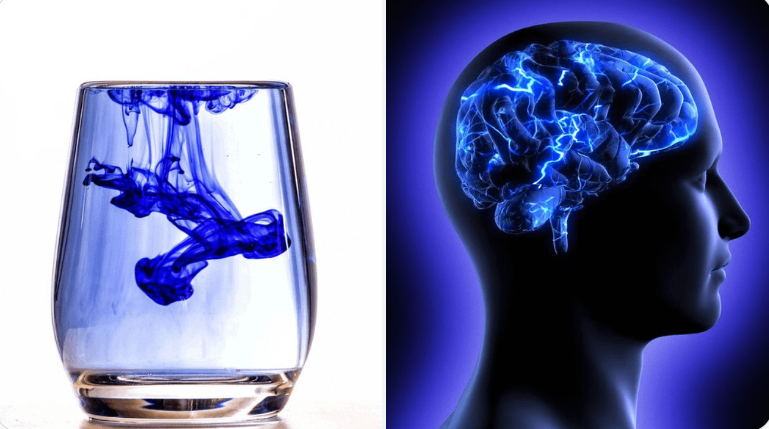
- “It turns your brain blue”
Can we talk about this please? If you’re seeing this picture, you know you’re looking at a hating on methylene blue post. Makes them an easy find.

When you see images of blue-stained brains, particularly in animal studies, it’s because methylene blue was administered before death. Why? Because it temporarily accumulates in tissues — especially those with high mitochondrial activity like the brain, heart, liver, and kidneys.
But this is NOT a bad thing. It’s exactly what makes methylene blue useful in functional medicine and neuroscience. It crosses the blood-brain barrier and preferentially concentrates in active tissues — ie, the ones that need the most mitochondrial support.
It is not neurotoxic. It’s the opposite of toxic. Many animal studies using methylene blue at therapeutic doses report neuroprotection, improved memory, and slowed neurodegeneration.
I’ll say this again, the dose matters here folks.
OK – one more debunk: people comparing methylene blue to fluoride.
This is just embarrassing. Comparing fluoride (a toxic halide added to drinking water) to methylene blue (a redox molecule used in medicine for over a century) is like comparing a B12 shot to … battery acid. They’re both “synthetized”, but the similarities end there.
Fluoride is a byproduct of industrial waste that absolutely does accumulates in bone and destroys thyroid function. It is a documented neurotoxin – see Harvard meta-analysis here. Unlike methylene blue, fluoride offers no mitochondrial or therapeutic benefit to offset these risks. Here’s my plug for drinking filtered water and using non-fluoridated toothpaste.
Can you hurt yourself with methylene blue? Sure you could – by taking too much. Everything is a “toxin” at the wrong dose. Even water – and kale.
How I Use Methylene Blue in Practice
Here’s how I use it at Lindgren Functional Medicine:
- Patients with brain fog, difficulty concentrating, or chronic fatigue
- Neurodegenerative concerns like early cognitive decline
- Post-viral syndrome (including long COVID)
- Combined with photobiomodulation (that’s methylene blue plus infrared sauna) for synergy
- Part of cancer adjunct protocols when appropriate
- With NAD+, CoQ10, and glutathione for mitochondrial support
Safety and Dosing
- Therapeutic range: 0.25 to 4 mg/kg – this is not medical advice, ask your own doctor
- Avoid with SSRIs, MAOIs, or in patients at risk for serotonin syndrome
- Always use USP-grade, pharmaceutical-quality MB. NOT aquarium cleaner. I repeat: NOT aquarium cleaner. And I wouldn’t use the liquid stuff from Amazon – even if it’s pharma grade. Unless you want blue teeth. But that’s apparently how RFJ J takes his, and his teeth look great. Me personally, drinking it has been a fail. Just with my teeth.
Final Thoughts
Methylene blue isn’t new, it isn’t hype, and it isn’t dangerous when used appropriately. It’s a powerful molecule that helps your cells breathe, think, and heal. And while Big Pharma can’t patent or make any money on it, that doesn’t mean it doesn’t work.
In fact, I strongly suspect that might be exactly why it’s getting trashed online. Just sayin’. Remember, you’re not a horse, y’all? What
So next time someone tells you methylene blue is just snake oil, you can tell them:
“Nope, it’s just mitochondrial and anti-aging support in a bottle. And my neurons are firing just fine, thank you very much. Yours?”
If the fact that it is synthesized bothers you, I completely respect that. Try blue spirulina instead. But then you also need to stop eating any food that you didn’t hunt or grow yourself. Peace out.